Understand why your clothes don’t fit your body shape and what you can do about it.
Why is it that you rarely find clothes that fit you well? Unless you are what’s termed a ‘clothes horse’ with a standard size and dimensional body (a person who loves clothes and generally looks great without effort) then, like almost everyone, you will have variations in your body shape and measurements which are not standard. And thank heavens for that, it celebrates our uniqueness!
We are not all the same and one size does not fit all.
The economic limitations of making ‘off the rack’ garments for retail sale requires manufacturers to produce ‘standard’ sizes, XS, S, M, L, XL, XXL etc. These generic sizes are based on ‘dress sizes’ for women and chest and inside leg measurements for men.
To get your clothes to fit well(i.e. in all areas) then you have three choices: get your retail purchases altered by a seamstress, invest in buying Couture or make them yourself.
Alterations can be done fairly cheaply by a good seamstress, making a garment look several times its cost when it fits well. This can be something as simple as reducing the fullness or length of a sleeve. It’s a small investment for a huge return.
Couture is a very different proposition and not a realistic choice for most people. The cost is a reflection of the work involved in producing a tailored, made-to-measure garment. Although this might involve a large initial outlay, a well-made garment which fits you well is an investment and will last for years if you take care of it. The ‘cost per wear’ is much less over time.
When I first started making my clothes I didn’t appreciate the nuances in sizing and being what I thought was a size 12 I bought a dress pattern and made the garment. As a complete novice, I had no understanding of the correct process. I had watched my mother and my sister sew but had not appreciated the elements of fit. Maybe they were lucky and had the ‘clothes horse’ body because I never saw them take the measurements and certainly not make a test garment, a ‘toile’.
Sadly both my mother and sister have passed so I can’t ask them. Maybe they adjusted the fit once they had finished the garment — which is what I suspect happened. My sister was a really good seamstress and had a successful alterations business but her being in the US and me in the UK meant that I was never able to sew alongside her or learn from her. Everything I know is by watching my mother, self-taught or gained from workshops I have done on particular techniques.
Making my clothes has given me an understanding of why ‘off the rack’ clothes sometimes do not fit me.
International Measurement

Standard sizes came in during the 1950s and changed in the 70s, increasing in size over time partly due to vanity but mostly because our body shapes have changed over time. Women were smaller overall in the 1950s due to the rationing of food during the war and people generally being more active than they are now.
International measurement sizes are used to make sewing patterns and do not relate to ‘off the rack’ sizes in retail. For instance, generally in retail sizes, I wear a size 10 shirt and size 12 trousers. As my first entry into sewing taught me — a size 12 dress pattern will not fit me. This is because my waist being 29 inches / 73.66 cm will be a size 15 UK and 13 US. This is because sewing pattern measurements use the ‘International Measurement Chart’ above.
Why is this different to retail sizing?
Brands choose the sizing of their garments
Unlike sewing pattern sizes which are consistent, there are variations in sizing between retail brands because a brand will set measurements based on their customer ‘profile’ — their ideal customer. This is why a size 16 in one shop may be right for you but 30 yards down the street when buying a different brand, a size 16 will not fit. There will also be variations from country to country based on cultural differences, perceptions and yet another measurement system.
Using the International Measurement Chart I have come to learn that I have to make some estimations as not all measurements will be a direct correlation — eg. My shoulder measurement is 4.5 inches or 11.43cm. The international measurement is 12cm / 4 3/4 inches = size UK 10 / US 8 — the closest to my measurement.
From the table below you can see the size variation needed across various body measurements needed for a perfect fit — which is why bought clothes rarely fit me perfectly.
When sewing from a pattern I would use a UK 15 pattern, as this is the ‘middle’ size and adjust the pattern to fit.
My sizes were calculated from the International Measurement Chart above.

So you can see there is no one size which would fit me perfectly.
Fitting is learning how to adjust and customise your clothes by applying your measurements to a sewing pattern or clothes you want to alter. This will make your clothes not only more attractive but also more comfortable. Those trousers that pull up or gather at the crutch or the shirt that constantly comes out of your skirt can be altered to stop them from doing this.
If your garments are well fitted they will look correctly loose-fitting and when they are close-fitting they will still allow freedom of movement and not be restrictive.
If you sew or just want to understand the differences between commercial patterns and your body shape, you can analyse it. It takes some time and will enable you to correctly adjust the fit and choose flattering styles which highlight your assets. Unless your weight changes you will only have to do this once and it will serve you well forever.
How to analyse your body shape
You can do this by tracing an outline of your body, this is more objective than looking in a mirror. You will need help to do this. It gives you a general outline of your body which shows your general body shape, (your silhouette), shows you length proportions and gives you guidelines which you can combine with actual body measurements.
I used a roll of wallpaper to do this which worked well. Draw a line lengthwise through the centre of the paper and then stick it to a door or wall. Stand in front of the paper with your heels against the wall or door. Stand normally with your head level. Ask your helper to draw a line around you and then to make marks at the top of your head, the left and right sides of the base of your neck, ends of the shoulders, underarms, waist, fullest part of the hips and centre of the knees.
Next, draw a line at the top of your head perpendicular to the centre line. Then draw lines connecting the various points you marked as above. You can see from my outline that you don’t have to be precise for this part of the process. This task will give you your length proportions.
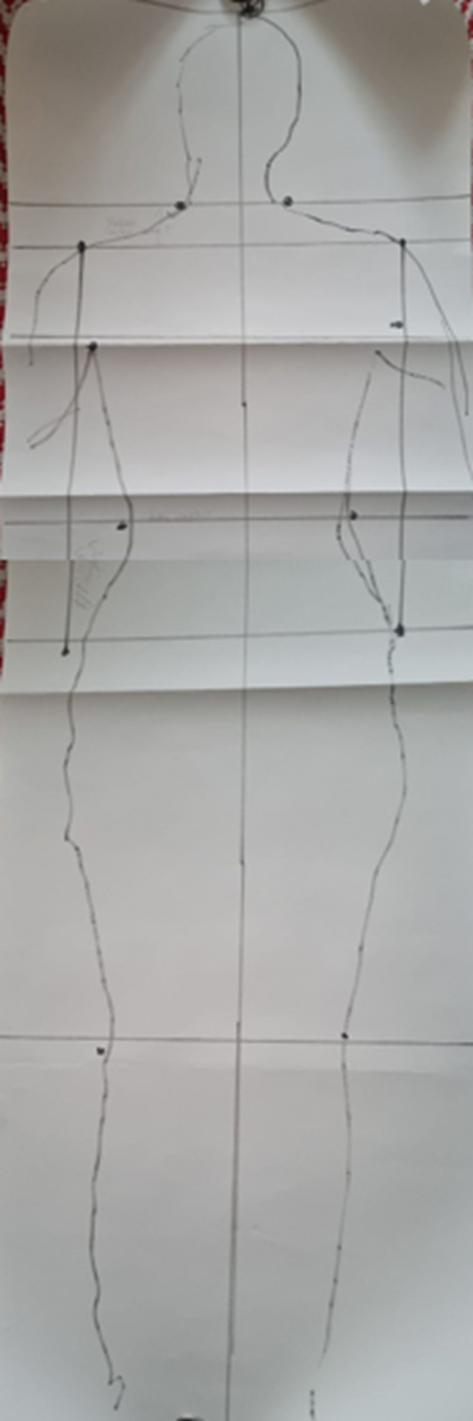
Take the paper and fold it in half, matching the top of your head to the bottom of the paper. Fold in half again. Match the underarm to the hipline and crease again. These lines will show the average length proportions for your hips, waist and knees.
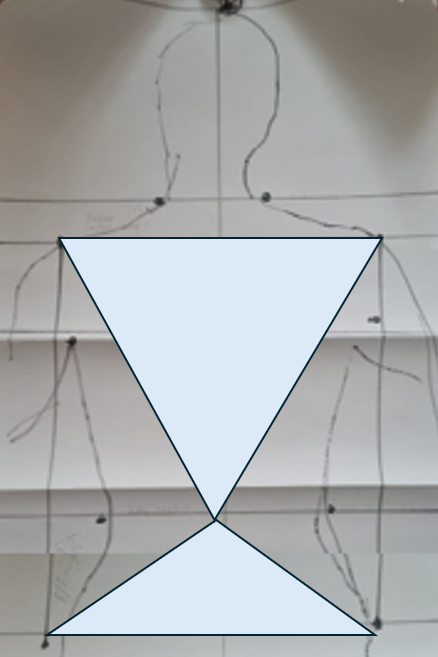
Join the shoulder and hip marks on both sides to indicate your body shape. You will now have your body outline as an abstract shape and can analyse your body objectively. You can see from my outline that my silhouette is shoulders and hips equally wide with a narrower waist.
So what did this tell me?
You can see from the diagram above that I am an ‘hourglass’ silhouette with what is termed ‘long waisted’. Broadly speaking this means the measurement from my waist to my hip is less than the measurement from my waist to my underarm and this is taken in proportion to my leg length from the crotch compared with the top of my head to the crotch.

‘Evenly proportioned’ would be the two measurements being roughly the same giving an overall shape of an hourglass and the torso and leg length being balanced.
Can you visually change your proportions?
Yes if you want to. There are style tricks to make a long waist look shorter for instance:
I can choose clothes that flatter my body silhouette such as wide high-rise waistbands which make my legs appear longer. I avoid drop-waisted garments and adjust sewing patterns to lengthen the bodice. The visual impression of the silhouette is that my shoulders are wider than my hips so a wide-shouldered jacket would accentuate this. A short tailored jacket with a hemline above the hip, or a longer jacket with a hemline below the hip will look much more balanced on me than jackets where the hem is on the hip. A jacket with a hemline between the hip and the knee is a visual illusion that my legs are longer.
There are lots of ways to visually change your proportions or to make clothes look even better. If you invest time to take your measurements and analyse your body shape you will benefit in the long term from being able to adjust your clothes and wear clothes that suit you better and are more comfortable.
 elaineflook.online